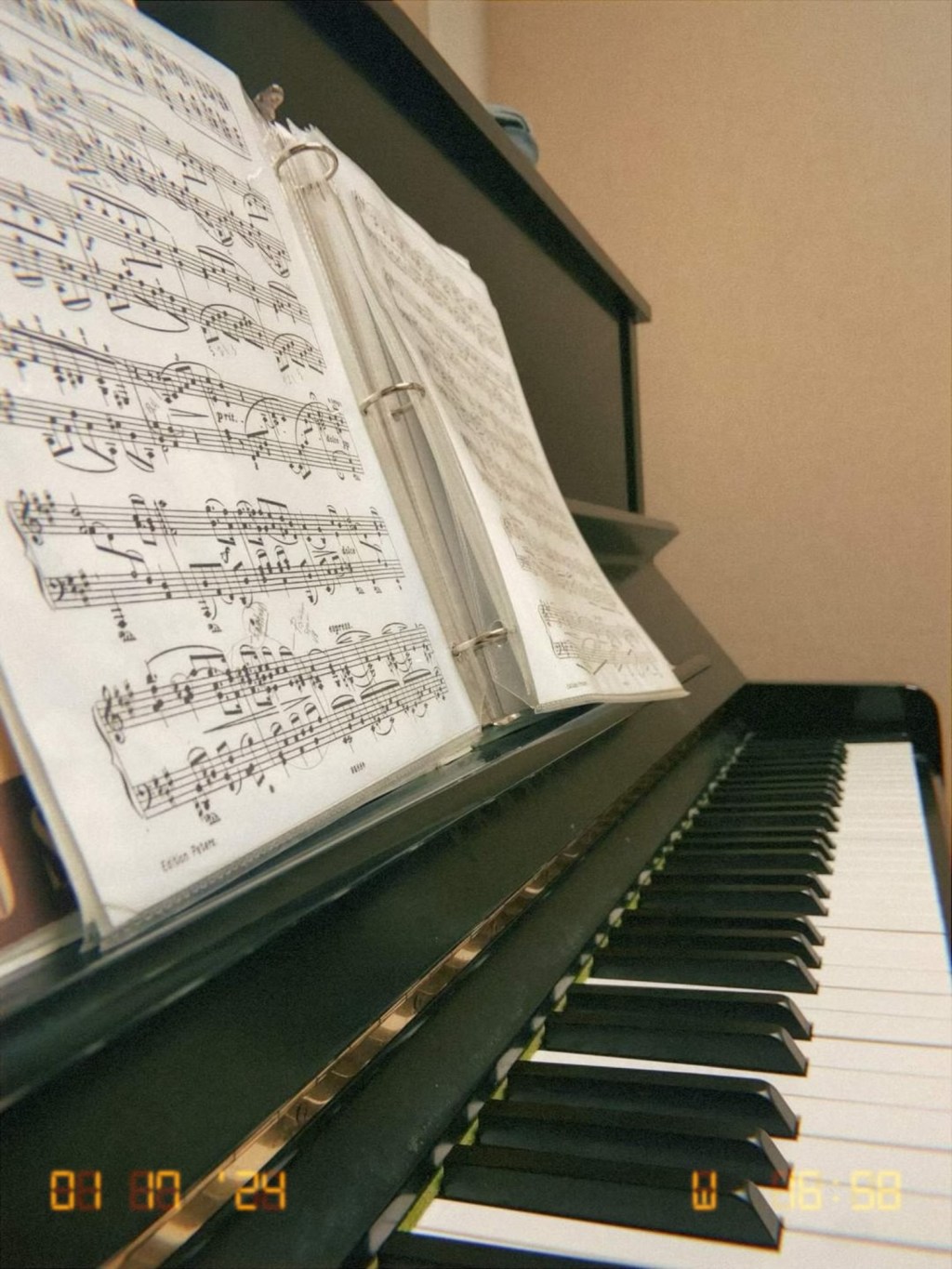
My goal is to write a collection of thoughts and revelations covering the course of my schooling as a pianist. These writings will explore the different traits I have acquired and lessons I have been taught due to my years as a pianist. My hope is that this will invite others to see the benefits of musical training, both scientifically proven as well as self-observed in my daily life, and perhaps be inspired to take up an instrument of their own.
“The ability to discipline yourself to delay gratification in the short term in order to enjoy greater rewards in the long term is the indispensable prerequisite for success.”
~ Brian Tracy
I cannot count how many times I have started to learn a piece on the piano, hit a wall, and wished I could just download the piece into my mind so I could instantly know it. Or when I start playing a piece for a specific part that I love, only to play that one part of the piece over and over again instead of learning the whole thing. While both of these options are much easier and take much less time, the route to learning a whole piano piece, while being a long (sometimes very long) and often tiring process, is necessary. The feeling of being able to play a piece on the piano, or any instrument, with the technicality and musicality required is a feeling set apart from any other. And it orbits around the idea of trading short-term fun for a bigger, long-term reward.
To reach this aforementioned goal, there must be hours and hours of patience and work put in, sometimes weeks, sometimes months, sometimes years. And it may feel excruciating at times. That one note you keep missing, even though you’ve been drilling it for the past 15 minutes; that run in the right hand that keeps tripping you up, no matter how slowly you’ve been working at it; that left hand trying to make a jump, but it somehow keeps evading the right notes, whether you’re closely watching it or not. So you try it slower and slower, again and again. And this action, as tedious as it might feel, is setting you up for success. And the moment you finally get that note right, or you make a clean run, or land that chord, the triumph you feel is unmatched.
However, the discipline required to make it to this point is not something that happens overnight. In fact, it’s not even a fixed trait. The ability to delay gratification requires practice, and is a muscle that needs hours upon hours of repetition to strengthen and grow, for it does grow! The area of the brain responsible for patience, impulse control, and goal-setting is the prefrontal cortex, and as you exercise it, the more it will grow. And one way your prefrontal cortex does grow, is through musical training.
In a study done in 2019, researchers tracked children, starting at 6 years old, across several years of musical training. In a classic delayed gratification task, children with three years of musical training consistently chose a larger, delayed reward over a smaller, immediate reward compared to the control group. The study noted that after 2 years, children with music training showed significantly greater bilateral activation in key cognitive control areas of the brain. Among these were the inferior frontal gyrus (IFG), which controls language, attention, and impulse stopping, and the anterior cingulate cortex (ACC), which controls decision-making and rewards, as well as detecting mistakes and adjusting future behavior.
In another study done in 2020, a randomized controlled trial looked at patients recovering from traumatic brain injury (TBI). TBI causes lifelong cognitive deficits, particularly impairments of executive functioning. However, neurological music training was shown to increase structural neuroplasticity in the prefrontal areas, specifically gray matter volume in the right inferior frontal gyrus. This suggests that neurological music therapy not only enhances executive brain functioning, but induces fine-grained neuroanatomical changes in prefrontal areas.
This leads us to several questions then. What does this research mean? What has this process of learning a piece taught me? What have the countless hours spent holed up in a practice room shown me about myself? And most of all, is this something I can take out of the practice room and into my daily life?
Well, music has power, and more power than we think. Practicing an instrument engages the brain in a multifaceted cognitive workout, thickening gray matter and strengthening good habits. These habits carry over into non-musical areas of life, teaching me that a single difficult temporary moment dims in comparison to the brightness of victory over hardship. That the time poured into something you love, something worthwhile, and something beautiful is never wasted, and in fact molds you and shapes you into becoming your truest self. It has shown me that I, in my passionate human self, would like what I want now, but how much more valuable it is when I have worked for what I desire. A flower does not bloom in an instant, and neither does a tree grow tall overnight; and so we appreciate them all the more for the time they must take.
Do not be discouraged, then, when you find yourself up against the imminent wall, and do not give into the allure of what may seem like a shortcut. Because I have found, through my years of musical training, that delayed gratification is a necessity, for without it, I would miss out on so much. So if something is hard and you don’t get it on the first try: good. Try again. And keep trying, for you never know what success lies around the corner.
References
Hennessy, S. L., Sachs, M. E., Ilari, B., & Habibi, A. (2019). Effects of Music Training on Inhibitory Control and Associated Neural Networks in School-Aged Children: A Longitudinal Study. Frontiers in neuroscience, 13, 1080. https://doi.org/10.3389/fnins.2019.01080
Siponkoski, S. T., Martínez-Molina, N., Kuusela, L., Laitinen, S., Holma, M., Ahlfors, M., Jordan-Kilkki, P., Ala-Kauhaluoma, K., Melkas, S., Pekkola, J., Rodriguez-Fornells, A., Laine, M., Ylinen, A., Rantanen, P., Koskinen, S., Lipsanen, J., & Särkämö, T. (2020). Music Therapy Enhances Executive Functions and Prefrontal Structural Neuroplasticity after Traumatic Brain Injury: Evidence from a Randomized Controlled Trial. Journal of neurotrauma, 37(4), 618–634. https://doi.org/10.1089/neu.2019.6413


Leave a Reply