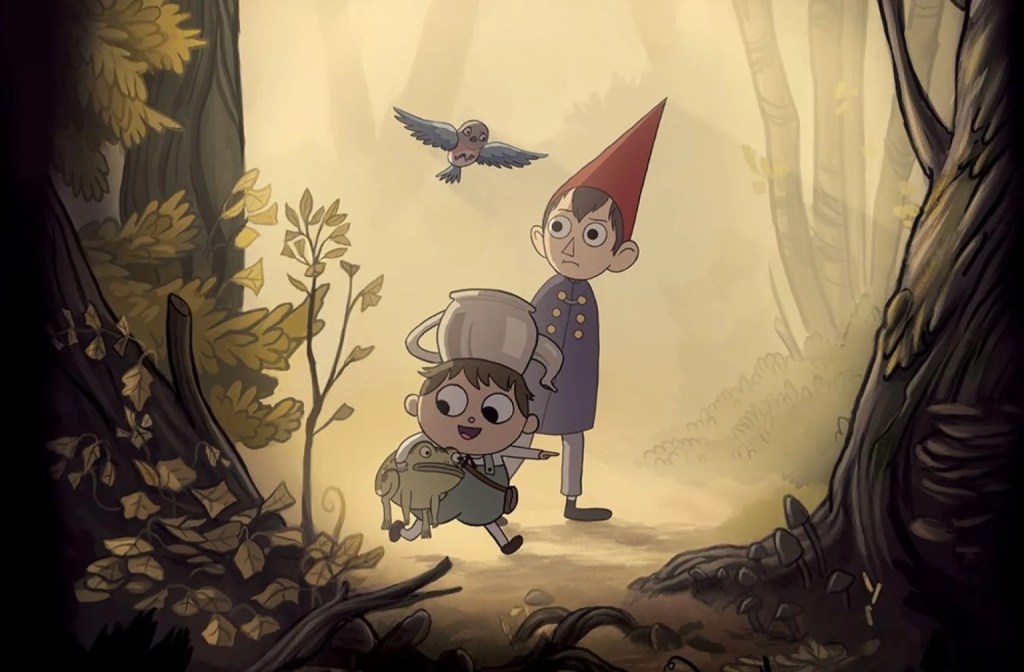
As fall officially begins and the first promising twinge of chill enters the air, I thought it fitting to write about my favorite fall show. I first watched this series on a road trip in the summer of 2023, quickly fell in love with it, and proceeded to watch it three more times that same trip. It had everything I could want in a show: a series of mysteries all wrapped into one big story, lost travelers finding their way home, odd characters, and quirky situations. But most importantly, an incredibly creative soundtrack that makes the world so special.
Over the Garden Wall is a ten-episode animated miniseries that was released on Cartoon Network in 2014. It climbed quickly in popularity, going on to win an Emmy for Outstanding Animated Program in 2015. Not only does it target the crisp, cozy, and whimsical transition of fall to winter, but it also incorporates themes of hope, bravery, and sacrifice. It follows the journey of two brothers, Wirt and Greg, who climb “over the garden wall” and into the unknown woods beyond. The series is set on Halloween in the modern day, but after entering the forest, they wander into a sort of “old America,” spanning anywhere from the 1600s to the early 1900s. As they try to find their way back home, they stumble upon different towns and characters, all with their own unique story to tell. In a mini-documentary on this series, Elijah Wood, the voice of Wirt, says, “If this show were a record, it would be played on a phonograph,” and this could not be truer, particularly after listening to the soundtrack. The Blasting Company, a musical group founded in 2008 by half-brothers Justin Rubenstein and J.R. Kaufman, was hired to create the score and soundtrack for OtGW, and took inspiration from a wide variety of styles and genres to weave together an album that spans centuries of musical evolution. Three of the songs on the album stood out to me due to the inspiration behind them, the history behind the inspiration, and the range of musical history that is covered in the span of just three songs.
The first of these is the second song on the soundtrack, “Into the Unknown,” which appears both in the first episode of Over the Garden Wall, “The Old Grist Mill,” as well as in the ninth episode, also titled “Into the Unknown.” It is sung by Jack Jones, a two-time Grammy Award winner whose career took off in the 1960’s, so his voice adds a nostalgic, classic effect to the song’s aesthetic. It begins with a short chromatic piano intro, setting the tone for the first half of the song. It begins in C# minor, a mysterious and melancholic key, with the words “led through the mist by the milk light of moon, all that is lost is revealed.” This song sets the tone for the whole series, introducing the viewer to the deep, dark forest of secrets that Wirt and Greg travel through.
The first section of the song ends with the lyrics “if dreams can’t come true, then why not pretend,” guiding the listener through a hopeful modulation into the B section in Db major. The lyrics here are “how the gentle wind beckons through the leaves as autumn colors fall,” accompanied by a descending melodic line, providing an auditory picture of the falling autumn colors. The song ends with the line “dancing in a swirl of golden memories; the loveliest lies of all,” suggesting that the darker, more haunting setting of the first section is a greater reality than the second.
The influence of the Romantic period is heavy in this song, most notably through its similarities to Frédéric Chopin’s (1810-1849) style of writing. What immediately stands out is the heavy and sorrowful mood the song first introduces. This is common in most of Chopin’s pieces, particularly in his nocturnes. In a Reddit post, The Blasting Company themselves said they drew heavily from Chopin’s nocturnes for inspiration, specifically his Nocturne Op. 9 No. 1 in B- flat minor.
The main contribution to the mood lies in the heavy use of chromaticism. Using Chopin’s B-flat minor nocturne as an example, he loves to weave in runs and turns with all sorts of notes in between those in the key signature. “Into the Unknown” is not as extravagant in its use of accidentals, but it still uses them quite frequently. The most notable is the opening line where it uses both a B-natural and a B-sharp, and then several measures later an A-sharp. The most common throughout the A section is the B-sharp, as this is the leading tone up to the tonic, C#.
Besides the mood, the song is filled with tempo rubato, which literally means “to rob time.” Rubato is a technique of playing freely and flexibly, speeding up and slowing down the rhythm for emotional expression. The song is in 3/4 time, but in the recording you hear a constant ebb and flow in the tempo of the piano, which parallels the theme of wandering throughout the show.
The next song that jumped out to me when listening through the soundtrack is titled “Pottsfield C.M.” This song appears during a scene in the episode “Hard Times at the Huskin’ Bee,” where Greg and Wirt stumble upon a harvest festival being celebrated by people dressed in dried corn husks and wearing carved pumpkins on their heads. They dance around a maypole in a barn, shucking corn, and bobbing for apples. The song begins with the repeated solfege “Fa”, “Sol,” “La,” and “Mi,” which are syllables used in a form of singing called “Shaped Note Singing” or “Sacred Harp Singing.” It gets its name from the shaped noteheads used to help singers learn their parts quickly by sight (a right triangle for fa, a circle for sol, a square for la, and a diamond for mi), while the “sacred harp” is the human voice singing hymns to God. This notation became a popular teaching device in American singing schools in the mid-19th century, after the publishing of the foundational songbook The Sacred Harp in 1844. Here is a really cool recording that is a great example of this kind of singing. Right off the bat, there is one difference worth noting, and that is that Sacred Harp Singing is typically a cappella. “Pottsfield” is accompanied by a string quartet, which, while not characteristic, is still very pretty. But I digress.
Besides the solfege used, another characteristic of “Pottsfield C.M.”, like shape note singing, is that it starts with the solfege and then moves on to the lyrics. It is typical to begin a song in that way to help all the singers learn their part by associating a syllable with each note. Then, the second time around, they sing the words to the song:
1. O hie thee forth o’er golden mead
Yon is the maypole set
A ribbon to wind thy soul,
And to bind love to thy breast
2. From flesh removed our chalk footfall
Tempers this holy ground
Where timeless spirits meet
‘round the heart of Pottsfield town.
(I am trying not to spoil anything for those who haven’t seen the show, but I will say these lyrics foreshadow an intriguing twist at the end of the episode!)
The last similarity is in the name itself: Pottsfield C.M. Many Sacred Harp songs are referred to by their tune name (often of a place) and their meter. C.M. is short for “Common Meter,” which is, as you might have guessed, the most common meter in Sacred Harp songbooks; ergo, “Pottsfield” is the tune name and “C.M.” is the meter in which it is sung. Common Meter has four iambic lines, with alternating lengths of 8 and 6 syllables (think “Amazing Grace”). However, although Pottsfield still works in the meter of 4/4, it doesn’t follow this pattern exactly and follows an approximate 8-6-7-7 or 8-6-6-7 syllable-per-line pattern.
The final example to show yet another change in style is “Send Me a Peach,” sung by Justin Rubenstein, one of the main members of The Blasting Company. The instrumental version plays in Episode 6, “Lullaby in Frogland,” during a chase scene with Greg and Wirt, which is rather ironic, as a chase scene is not the first thing that comes to mind when listening to this song. The instrumentation is simple and has the 1940’s-50’s crooner characteristics, through the “oo’s” and “ba-bum’s” in the voices and the light strumming of the ukulele that keeps the beat, to the intimate, heartfelt vocals of the main melody. The lyrics of this song are about someone missing their lover who is all the way in Georgia. Wherever the singer is, it is far away from her; it’s winter there, and he’s feeling cold without her by his side, so he asks her to send him “one little peach, just a sweet sunny piece of you.”
This song has a similar feel to “Dream a Little Dream of Me,” released in 1950, with Ella Fitzgerald and Louis Armstrong, minus the scatting. The background in this song is with Sy Oliver’s backing orchestra and, of course, Louis Armstrong’s signature trumpet. The orchestra functions in the same way that the guitar and background vocals do in the recording of “Send Me a Peach.”
Another song that has a similar-sounding melody is “Blue Moon,” released in 1957, by Elvis Presley. It has the same gloomy and wistful melody, although with very little background instrumentation. “Send Me a Peach” captures the essence of these two songs very well, both being hits of the 50s.
These three songs just scratch the surface of the musical range in this soundtrack. Some more of my favorites are “Prelude (Over the Garden Wall),” a string quartet piece, reminiscent of Copland’s Appalachian Spring; “Endicott Manor,” another string quartet piece, this time set in the early- to mid-1700s and very classical; “Come Wayward Souls,” an operatic aria sung by The Beast; and finally, “Potatus et Mollasus,” a Latin requiem reimagining of Greg’s song “Potatoes and Molasses.” It was so much fun to dive into this soundtrack and see the creativity and variety that The Blasting Company poured into it. Even if you haven’t seen the show, listening to the soundtrack alone tells a story in itself, even more proof that there was considerable thought put into its making.
There aren’t a lot of videos or articles on the soundtrack, but what I did find was so interesting, particularly this video by Overdoo Productions. He does a marvelous job explaining the nostalgia behind the soundtrack, how it achieves that feeling so well, and what makes American music “American.”
All in all, I learned a lot, and I really enjoyed writing this post. Let me know if you’ve watched the series and what you think – enjoy!
‘Till next time,
Charlotte


Leave a Reply